
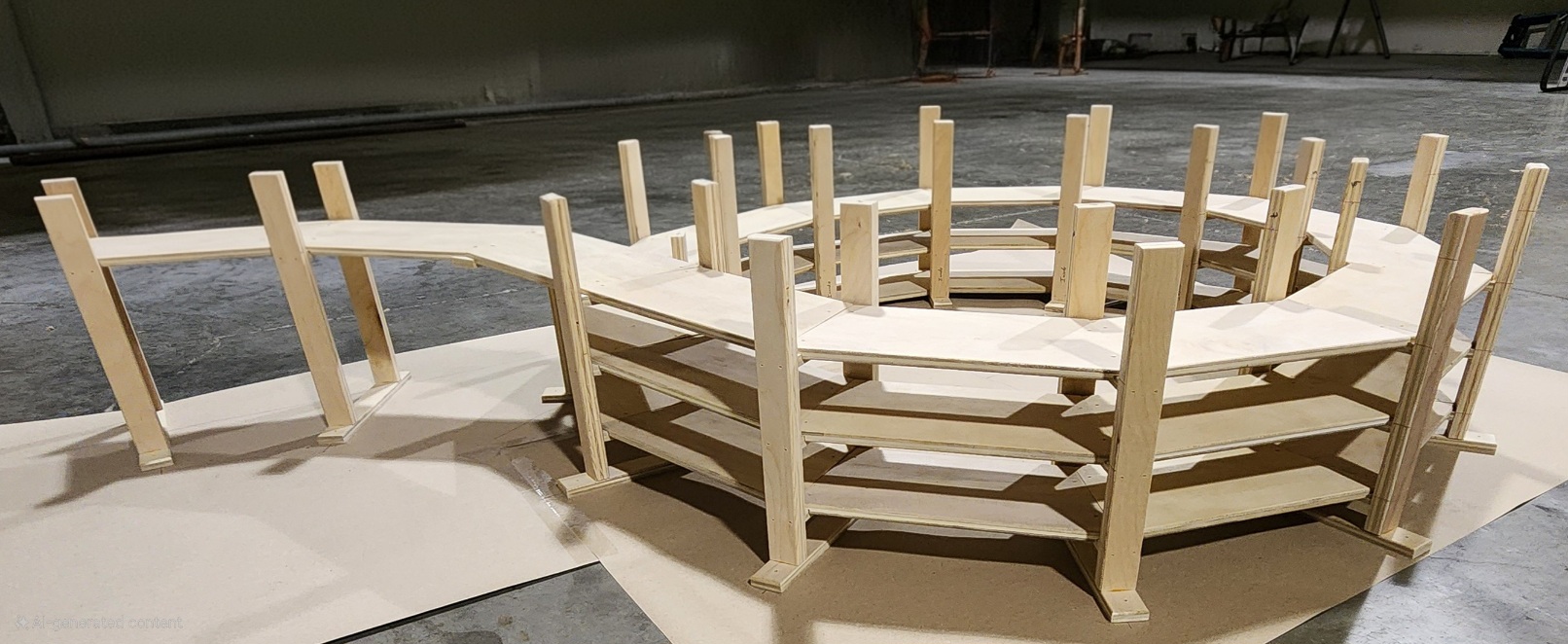
How do you build a helix for model trains?
The short answer is that you build it twice: first on paper or in a design tool, and then in wood. The first version protects the second version. A model train helix is not just a stack of curved plywood pieces. It is a working grade, a clearance envelope, a support structure, and a repeating set of parts that must remain consistent from bottom to top.
A helix usually has one main job: move trains between layout levels while using less linear wall space than a long visible grade. That makes it attractive for multi-deck layouts, staging yards, hidden connections, and layouts where elevation changes are part of the plan. But a helix can also become one of the most demanding benchwork projects on the railroad because every turn depends on accurate spacing and alignment.
Begin with the operating requirement. What is the actual vertical distance you need to gain? Then choose a radius that suits your scale and equipment. Next, calculate the grade. If the grade is too steep, even a beautifully built helix can become a bottleneck. Locomotives may slip, train length may need to be shortened, and hidden derailments may become harder to reach.
Currently available online helix calculators end at the planning stage
After the basic math, you need to move into the parts planning. You need to know the width of the roadbed, the number of segments, the outside size, and how the pieces will be supported among other things. It is also important to think about access. A helix hidden in a corner may look efficient until a derailment happens inside it.
The problem is that online helix calculator tools do not tell you this information. It is left up to the builder to determine. Online tutorials and videos may show the basic process but lack specific measurements and considerations unique to your model railway helix. The result? frustration and often a lot of wasted time and materials.
This is where a complete system makes a difference
The Helix Builder™ Digital Helix Design & Build Package is intended for builders who want more than a sketch, a vague fabrication process, and a set of parameters to incorporate into an actual helix. It is a complete design and build system that helps organize the planning process with a browser-based helix design tool, complete PDF drawings, cut-list information, and reference material so the construction phase of your helix goes smoothly and reliably.
Common helix-building issues due to insufficient or accurate information:
- Grade creep: A small rise increase can make the grade harder than expected and result in a taller overall helix height. Trying to compensate for that error results in inconsistent grades per turn.
- Clearance problems: Roadbed and support thickness that are not taken into account can reduce usable vertical space.
- Footprint surprise: The outside diameter can be much larger than the track radius suggests.
- Repeated cutting errors: One wrong manual measurement calculation can affect every section.
- Access limitations: Hidden track still needs maintenance and rescue access.
Many modelers ask the helix question after they already have a track plan. A better approach is to make the helix part of the planning process from the beginning. It affects aisle space, benchwork height, staging design, scenery transitions, and the way operators move around the layout.
If you are ready to turn the idea into a more buildable plan, review the Helix Builder™ package. It gives the do-it-yourself modeler a way to move from “I think this will work” to a definitive organized plan for cutting and assembly.
Benchwork Builder Pro, PDF Benchwork Plan Packages, Digital PDF Model Railroad Table Plan Packages, “PRO” Digital Benchwork Plan Packages, Model Railroad Benchwork Cut List & Plan Generator, Helix Builder, EZ-FOLD NTRAK Modules, EZ-FOLD Free-Mo Modules, and The Model Railroad Benchwork Store are Trademarks of The Model Railroad Benchwork Store/Model Railway Techniques.com and may not be reproduced, copied, or redistributed in any way without prior written consent by The Model Railroad Benchwork Store/Model Railway Techniques.com
Copyright 2026 The Model Railroad Benchwork Store/Model Railway Techniques.com All Rights Reserved
Last Updated on 2 months ago ago by James from Model Railway Techniques